

Most cars lose value the moment they leave the dealership lot, but a tiny fraction become six‑figure assets. Wealthy collectors are no longer looking only at stocks and real estate; they are parking some of their portfolio in classic cars like Ferraris, Gullwings, and early 911s that have outpaced many traditional assets over the past decade.
At a Barrett-Jackson auction in Arizona recently, someone paid over $300,000 for a fully restored 1967 Mustang Eleanor Fastback, made famous in Gone in 60 Seconds (2000).
That’s high level, though. Many people buy the original car and restore it themselves, or have someone restore it for them. Some look to sell, to re-coup the investment, maybe generate a profit. The costs going that route are “absolutely huge”, says Tim Winton, the founder of Cambrian Classics, a family-run businesses specializing in classic car repair and servicing, located in Wales, is just the person, whether it’s hands-on, bringing your classic car in for servicing, or consultation over a Zoom call.
In calculating return on investment, instead of doing a body-off restoration, the car owner might opt to do a body-on. The “body on” restoration keeps the car together, focusing on fixing or refinishing parts like paint, upholstery, or trim, keeping the frame intact. It’s less invasive, quicker and cheaper. “Body off” is next level – removing the body from the frame to sandblast, repair, or replace component completely.
That’s where the expertise of someone like Winton comes into play. Winton has run a local MG club for 15 years, and five years ago quit a job as a garage manager at a Renault dealership to fix classic cars full-time.

1962 Corvette Roadster, Canadian International AutoShow, Toronto, image by Mark Keast

1954 Porsche Speedster, Canadian International AutoShow, Toronto, image by Mark Keast
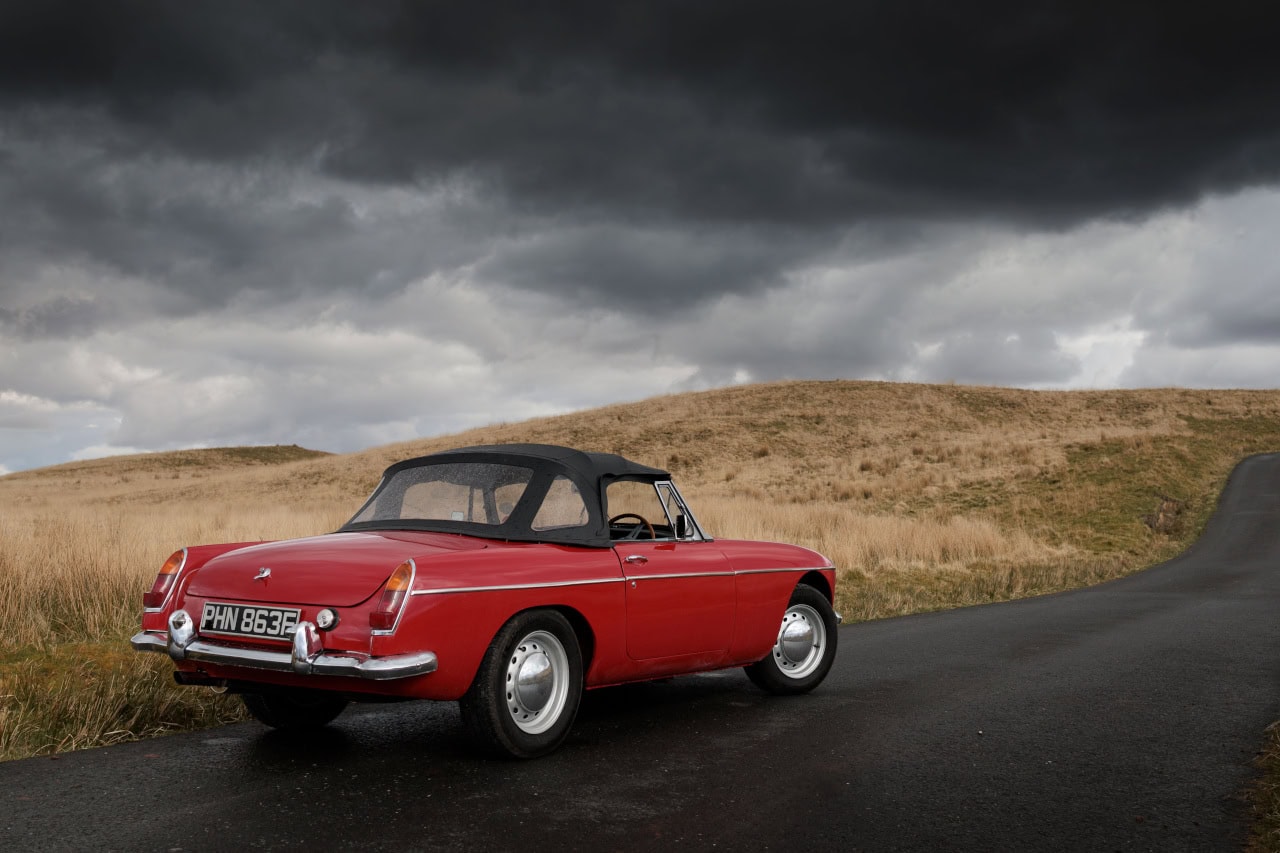
You can feel the way the car moves under you when you’re throwing it into a corner. We’re driving with the roof down, in my MG, which is particularly sporty, and chucking that into the bends and really exploring a nice twisty, fast day road, what we call ‘giving it the beans’, making it rev. That’s fun to me.

Image: Cambrian Classics
What Is Cambrian Classics?
Tim Winton is the founder of Cambrian Classics Ltd, a family-run business that specializes in classic car repair and servicing and is located by the beautiful Ceredigion coast, in Wales. Cambrian Classics offers services that range from restoration and repair work to regular servicing and maintenance.
Cambrian Classics is a recommended garage for both the MG Owner’s Club and Just Kampers, and regularly works on pre-1980’s classic cars, including pre-war vintage vehicles. Cambrian Classics specializes in a variety of classic marques including MG, Austin-Healey, Rolls Royce and Bentley, Alfa Romeo, Mercedes, BMW, Triumph, Volkswagen, Morris, Land Rover, Mini, and Rover.
“It’s got super busy, super quick,” says Winton about his business. There are five of them on staff now. MGs have always been his passion – a good classic car to start with, since they are fairly cheap to buy, parts are readily available, and there’s a good club scene. When he bought his first MG for 1200 pounds, he quickly discovered it was expensive to have other people fix it.
For me, it was the same, going back to my university days over 30 years ago, when I purchased a Triumph Spitfire, but quickly ended up selling it because of the repair costs.
Buying, fixing, then selling classic cars was something that snowballed for Winton. People at the local club started coming to him to fix up their cars. He’s about to sell his current MG that he fixed up, after putting in a bigger valve engine and five-speed gearbox, and will be expanding his workshop.

Tim Winton, Cambrian Classics
What Is a Classic Car?
By definition, classic cars, like Mustangs, Corvettes, Mercedes, Volkswagens, are usually from around 25 to 50 years ago, that are valued for design, style and the historical significance behind it. American classic cars are known more for horsepower, European classic cars more for precision.
For Winton, what makes them special comes down to the experience, how it makes you feel behind the wheel. Winton gets that feeling behind the wheel of his MG, driving by the dramatic cliffs, sandy beaches and villages along Cardigan Bay.
“You’re far more connected,” he says. “Modern cars are more sanitized, in order to make them more comfortable for long distances and not tiring for drivers. The steering is very light, which makes them more relaxing to drive, but you have less feedback off the car, off what’s happening under the tires. Classic cars are far more engaged, through direct steering.
“You can feel when the road’s a bit greasy. You can feel the way cut the car moves under you when you’re throwing it into a corner. We’re driving with the roof down, with my MG, which is particularly sporty, and chucking that into the bends and really exploring a nice twisty, fast day road, giving it, what we call ‘giving it the beans’, making it rev. That’s fun to me.”
There is no one answer to the joys of classic car driving – it depends on whom you ask. “Authentic” is a word used consistently, however.


Images: Cambrian Classics
Are Classic Cars Luxury?
Take a peak at a typical Barrett-Jackson auction, and what cars are selling for at those shows, if you doubt whether classic cars are luxury items. The Arizona auction is coming up (Jan. 17-25 in Scottsdale), with over 2,000 collector cars and trucks.
Some of the auction highlights for the upcoming show:
- A highly anticipated offering is a 2023 Brabus 900 Rocket R, the first of 25 produced worldwide and one of two legal for use in the U.S. Finished in Mexico Blue, it is powered by a Brabus-tuned twin-turbocharged flat-6 capable of 0 to 60 mph in under 2.5 seconds, 0 to 120 mph in 7.2 seconds and a top speed exceeding 211 mph.
- The 2017 Ford GT formerly owned by actor Tim Allen is powered by a twin-turbo 3.5-liter V6 with a 7-speed dual-clutch transaxle and features the Dark Energy interior.
- One of 541 produced in the limited-edition color, Tungsten Gray, a 2006 Ford GT features silver painted racing stripes, forged BBS lightweight wheels and red brake calipers.
- Known as “The Rebel,” a 1950 Mercury is among the custom collectibles consigned for the January event. Professionally chopped by Joe Bailon, this custom Mercury retains an all-steel body and is powered by a mid-1980s Lincoln fuel-injected V8 engine paired with a 4-speed automatic overdrive transmission.
Classic cars span the spectrum from budget icons to ultra-exclusive masterpieces. Some were born luxury, others earn that status over time through rarity and demand. Back to that 1967 Mustang – they weren’t luxury cars, instead were affordable, sporty coupes for the masses. But today? A car like that is a collector’s grail, commanding insane prices because of scarcity, iconic status, and nostalgic hype. Its auction value makes it luxury in today’s market. Think of it as art, not just transport. Still, back in 1967, you could’ve bought one for under four thousand dollars.

Images: Cambrian Classics
How Do I Invest in Classic Cars?
Car shows and auctions are the place to go. Winton says the market for classic cars has typically been Boomer-aged people, but younger generations are drifting towards them now, and that’s affecting values.
“From my perspective and experience, the younger generations, I don’t think they’re so particular in going, I really want a Porsche, or I really want a Bentley, or something like that,” he says. “They just want a classic car.”
Electric vehicles may end up being the the saviour of classic cars.
“It enables people to keep using petrol by reducing that demand on it,” he said. “And I don’t think they’re in direct competition with each other. (Classic cars) are a pleasure car rather than a necessity car. They are an investment purchase.”
5 Biggest North American Classic Car Shows
Plunkett set the mark in Ontaario when he was running his show. Elsewhere in North America: The Amelia Island Concours d’Elegance down in Florida, March 5th through 9th.
Then there’s Mecum auctions in Kissimmee, same week, early March. The Run to the Sun in Myrtle Beach, South Carolina, draws huge crowds for cruisers and trucks, March 19-21. Pebble Beach Concours is the gold standard out west, August 13-17.
And don’t miss the Goodguys events – they’re all over, like Scottsdale in January or the Nationals in Columbus, Ohio, July 17-20.
Classic Cars: What Questions Do I Ask?
“Generally speaking, you get what you pay for,” Winton says. “Buy the best you can afford. If you’re not a mechanical, practical person, and you’re going to be like most people, paying someone to maintain the car, then buy the best one that you can find.”
Bring an expert with you.
“I get the call a lot of times. I’ve just bought a car, they will say. Can you give it a check over, make sure it’s okay? Again, there’s the list of things that it needed. So have someone with you at the time, so you either have some room to negotiate in the price or just be aware of what you’re buying. Cars can look great on the outside, but an experienced ear will start it up, put the foot in the clutch and go, that release bearing is bad.
Ask about the car’s maintenance history (get receipts) and ask about its history – where it came from.
“On some cars changing a clutch is not easy. A lot of old sports cars, you’ve got to take the engine out. You can’t just take the transmission out from underneath. You’ve got to take the whole engine out. And in some cars, that means taking some of the body work apart. It really depends what car you buying, so knowing that that’s an issue when you buy can save you a lot of money.”

Tim Winton driving his MG, image courtesy Cambrian Classics
Body work is everything. Mechanically, classic cars are quite simple, Winton says. Yes, mechanically they can still be expensive to repair financially, but nothing compared to having to do a substantial amount of paint work.
“Consider your maintenance budget as well as your purchase budget,” he says. Buy an MG, parts are cheap. Buy a Porsche, parts are not cheap. “I had a Bentley in recently and I couldn’t believe how expensive the parts were for it.”
A wheel cylinder on an MG is around 15-20 pounds. On a Bentley it’s 250 pounds – four on the front axle, two on the back, that’s over 1200 pounds just for wheel cylinders, he adds..
Do your due diligence – find someone locally who can fix the car for you, beforehand, someone who understands classic engines.
“General garages are now really struggling with the knowledge base for older cars,” he says. “Cars have been fuel injection for a really long time, and all the garages are now there for plugging in diagnostics. And that’s very different than having to use your brain and think about the engine in different ways.”
Are Classic Cars a Good Investment?
If you are looking at classic cars as an investment, like Plunkett says, figure out what you want. Winton is there to act as a consultant as well as actually fixing the cars. Most of his customers are in Wales, a few from Ireland, who bring them over on the ferry. As the older mechanics fade away, Winton’s business will no doubt pick up (he’ll even get on a Zoom call with people from North America, for consultancy purposes). His crew are specialists in all pre-1980 classic cars, all the way back to pre-war.
If I was going to run out and buy a 1969 Firebird, I am going to want someone like Winton on the speed dial to direct questions to. He had someone from Australia reach out, asking Winton to build him an engine.
“With the resto mods, it is one thing tuning a classic car with classic technology, but the minute you put a modern engine in it, you’re really restricting the number of people that are going to want to buy it. There will be someone out there that goes, that looks great with that engine in it. I want to go fast, do all of those things. But the cost of doing that work is quite expensive, and from the cars that I’ve seen, people never really get their money back again.”
Putting a 16 valve engine into an MG, on the other hand, doesn’t do a thing to its value.
“How well is the restoration been done?” says Winton. “Because I’ve seen cars that have been restored, and it’s very, varied. Just know that come time to sell, you might not get all your money back. But in the end it all depends why you’re buying a classic car.”
How Has the Market for Classic Cars Changed?
“Like in any market, supply and demand, the things that affect values,” says Winton. “And we’ve seen generally there’s a decline in values of pre- war vintage cars, because the supply has grown. The older gentlemen who have been enthusiastic about those cars are starting to decline in numbers. Therefore there are more cars coming to market, and the relative cost of repairing and maintaining them, the parts supply is much harder off, things have to be custom made, and there isn’t that market backup. So the prices have dropped quite a bit in the last five years.”
Classics cars from the 50s, 60s, 70s, they’re holding steady in prices, he adds There’s a good supply, and there’s still a good demand from people, including people Winton’s age, who can now afford these cars. Or they’re inheriting them from their parents.
“Then there’s a rise in modern classics and import cars, from your 80s, 90s and 2000s, and your Fast and Furious cars,” he says. “Your Japanese cars and Datsuns, is gaining traction. Those values are slowly increasing, because, again, people my age watched Fast and Furious when they were younger.”

Mark Keast has been a journalist for three decades, starting out as a sports writer and editor for one of Toronto’s largest daily newspapers. Recently he has moved into writing on luxury cars, travel, and Toronto luxury real estate. He owns real estate in downtown Toronto as well, so there’s a vested interest there. Mark spends a lot of his work time connecting with realtors and developers across Canada, staying on top of industry developments.
Check out his stories, and email him direct at mkeast@regardingluxury.com